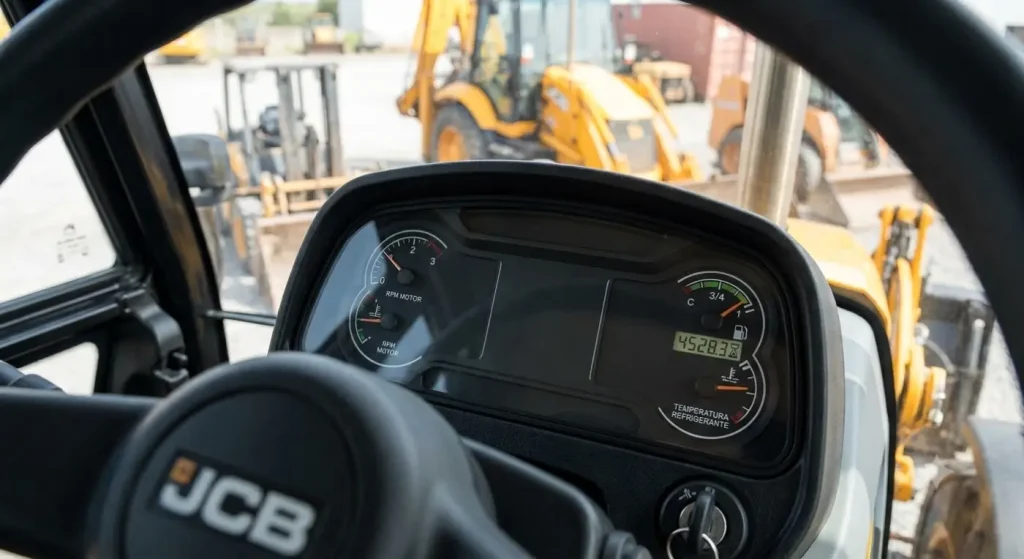
How many hours are too many for a used excavator?
“How many hours does it have?”
It’s probably the first question we get when we list a machine.
And that’s perfectly normal.
Hours are one of the first things any buyer looks at when considering used machinery. But they’re also one of the things that cause the most confusion.
Because in this industry, we’ve seen it all:
Machines with low hours that are completely worn out.
And machines with high hours that are still in very good condition.
That’s why, when we’re asked how many hours are too many, our answer is always the same:
It’s not just the number of hours that matters, but how those hours were accumulated.
Two machines, two very different realities
Some time ago, we assessed two similar machines.
One had around 6,000 hours.
The other had more than 14,000.
On paper, the choice seemed obvious.
But once we inspected them, the reality was very different.
The machine with more hours:
- Proper and consistent maintenance.
- Used in relatively light working conditions.
- Hydraulic system in good condition.
- Minimal play in components.
The machine with fewer hours:
- Irregular maintenance.
- Used in more demanding conditions.
- Noticeable play in components.
- Premature wear in several areas.
Conclusion: the machine with 14,000 hours was the better buy.
Not all operating hours are equal
One operating hour doesn’t always mean the same thing.
An excavator used for light earthmoving work is not the same as a machine working in a quarry or on demolition projects.
Wear depends much more on how the machine has been used than on the number of hours alone.
That’s why we always ask:
- What type of work has it performed?
- In what kind of environment?
- How many operators have used it?
These answers tell us more than the hour meter.
Operating hour ranges (a practical guide)
There are no fixed rules, but there are some useful guidelines:
Up to 5,000 hours
Relatively young machines. Even so, they can be in poor condition if they haven’t been properly maintained.
5,000 – 10,000 hours
A very common range. At this stage, maintenance history becomes crucial.
10,000 – 15,000 hours
These can still be perfectly good machines, but the hydraulic system, engine and component play should be inspected more carefully.
More than 15,000 hours
This isn’t necessarily a problem in itself. We’ve seen machines with this many hours that are still in very good condition.
What we look at before the operating hours
When we assess a machine for our stock, the hour meter is just one piece of information.
What really matters is the machine’s actual condition.
Play in components
This can reveal how heavily the machine has actually been used and the type of work it has performed.
Hydraulic system
One of the most expensive areas to repair:
- Pumps.
- Cylinders.
- Control valves.
- Leaks.
Engine
An engine can last for many thousands of hours if it has been properly maintained.
Maintenance
When there is a documented service history, everything changes:
- Invoices.
- Inspections and servicing.
- Documented repairs and maintenance work.
Yes, operating hours can be manipulated
It’s a reality.
That’s why we never recommend making a decision based solely on the hour meter.
There are much more reliable signs:
- Seat wear.
- Pedal wear.
- Control wear.
- The overall condition of the cab.
The machine always tells its own story.
Hours don’t pay for repairs
Two typical examples:
Machine A:
- 7,000 hours
- Poor maintenance
- Hydraulic leaks
- Significant play in components
Machine B:
- 12,000 hours
- Proper maintenance
- Good overall condition
- Proper operation
Which one is the better buy?
The hour meter doesn’t decide.
The machine’s condition does.
So… how many hours are too many?
There is no magic number.
What really matters is:
- How those hours were accumulated.
- How well the machine has been maintained.
- What condition it is in today.
A machine with high operating hours can continue working reliably for many years.
And a machine with low hours can develop problems very quickly.
What we’ve learned at BANERAI
After many years in this industry, the conclusion is clear:
don’t buy hours, buy condition.
Hours provide information.
But they don’t make the decision.
And when it comes to used machinery, the real difference is rarely found on the hour meter, but in everything that number doesn’t tell you.
Looking for used construction machinery?
At BANERAI, we assess every machine beyond its operating hours. We inspect its condition, maintenance history, documentation and actual performance before offering it for sale.
If you need advice, we’ll be happy to help you choose the best option for your work.